
Every second, millions of fingers across six continents swipe upward. Within milliseconds, a seamless, high-definition, hyper-personalized vertical video fills the screen. There is no buffering circle. There is no perception of lag. To the average consumer, this frictionless delivery feels like digital magic. To an engineer or corporate financial officer, it represents one of the most aggressively complex, capital-intensive, and resource-heavy technological undertakings in human history.
TikTok has officially scaled to over 2 billion monthly active users worldwide. Managing a platform of this scale requires more than just an incredibly precise algorithm; it demands an unparalleled global physical infrastructure. To keep this engine humming, its parent company, [ByteDance](https://wikipedia.org), directs cash flows into data center facilities, specialized transcontinental fiber-optic bandwidth networks, legal frameworks, and a highly compensated global army of corporate technicians.
This comprehensive architectural and financial autopsy looks directly at the real numbers behind TikTok’s internal balance sheet. We will examine the sheer volume of global employees running the operation, map out the planetary scale of their server clusters, and quantify exactly what it costs to fund this machine on a daily, hourly, and minute-by-minute basis.
1. The Global Workforce: Counting TikTok’s Human Capital
Behind the automated algorithmic recommendations is an expansive corporate workforce distributed across highly competitive markets like Los Angeles, Singapore, London, Dublin, and Tokyo. While the public often views TikTok as a self-sustaining code script, the human capital required to iterate the product, field compliance requests, and run localized consumer programs is immense.
The Corporate Split: TikTok vs. ByteDance
To accurately assess TikTok’s human resource expenditure, a structural distinction must be made between standalone TikTok personnel and the shared services provided by its parent conglomerate, ByteDance. ByteDance operates an ecosystem of apps, including the Chinese-market short-video equivalent Douyin, the editing platform CapCut, the enterprise suite Lark, and various deep-learning AI projects.
- Dedicated TikTok Staff: Independent organizational tracking shows that TikTok maintains approximately 57,304 dedicated corporate employees globally. This core team focuses directly on software engineering, product development, user experience design, localization, and ad-sales infrastructure.
- The Parent Conglomerate Umbrella: ByteDance’s total global workforce exceeds 120,000 employees. Thousands of these corporate entities—particularly those in core system architecture research, corporate security, and content moderation systems—contribute directly to TikTok’s infrastructure on a shared-services basis.
Geographic Distribution of Talent
TikTok’s strategic decision to decouple its operational infrastructure from unified hubs has resulted in a distributed corporate model. The company’s primary dual headquarters are situated in Los Angeles and Singapore. However, regional engineering offices and regulatory operations are scattered globally:
In the United States, despite intense geopolitical headwind and restructuring procedures to integrate local data custody partnerships with Oracle Corp, TikTok maintains an anchor workforce of roughly 7,000 corporate professionals. In the European theater, headquartered out of London, the staff has expanded rapidly to over 4,300 personnel, driving local data compliance initiatives and enterprise sales across the UK and the EU.
This workforce does not come cheap. Tech sector compensation for distributed cloud specialists, algorithm scientists, and senior product directors averages north of $180,000 to $350,000 annually when factoring in base pay, health insurance allocations, stock-based compensation metrics, and bonus pools. The human resource burn rate alone commands billions of dollars in annual capital allocation.
2. Decoding the Server & Cloud Infrastructure Costs
If human capital represents the brain of TikTok, the server architecture represents its physical cardiovascular system. The media architecture of TikTok is inherently heavier than text- or photo-based networks like X (formerly Twitter) or Instagram’s legacy feeds. Every user session consists of an unbroken, high-bitrate video stream tailored on the fly by an AI model that recalculates preferences after every swipe.
Table of Contents
The Bandwidth Burden of High-Definition Vertical Streaming
To deliver video files immediately without latency, TikTok relies heavily on localized Content Delivery Networks (CDNs) and deep edge-compute caching. When a creator uploads a video, it is ingested, transcoded into dozens of different resolutions and codecs (such as H.264, H.265, and AV1), and replicated across thousands of servers worldwide. This ensures that when a user in Hamburg or Sydney requests that specific piece of content, it is pulled from a server only a few miles away, rather than across an ocean.
Data science estimates place TikTok’s annualized global server, cloud storage, and public internet transit bandwidth costs at approximately $5.0 Billion USD. Breaking this staggering figure down reveals the sheer magnitude of daily physical maintenance:
Annual Infrastructure Outlay: $5,000,000,000 USD
Daily Infrastructure Burn Rate: ~$13,700,000 USD per day
Hourly Server Cost: ~$570,833 USD per hour
Per-Minute Infrastructure Maintenance: ~$9,513 USD per minute
Data Center Regionalization: Project Clover and Project Texas
In response to international regulatory mandates surrounding data sovereignty and user privacy, ByteDance has transitioned away from centralized storage frameworks. This has forced the company to execute multi-billion-dollar localized infrastructure deployments that artificially inflate traditional engineering operating expenses.
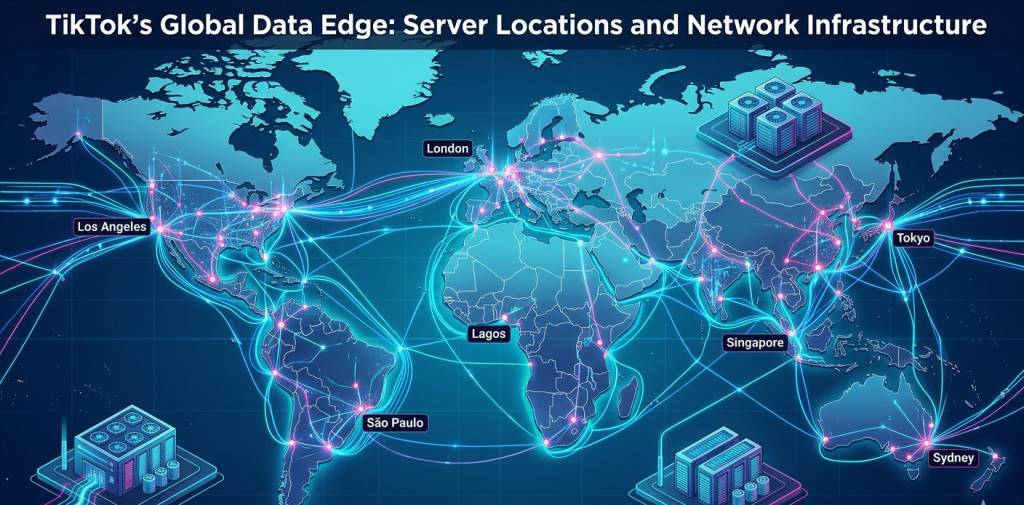
In Europe, through an initiative known as Project Clover, TikTok has committed over $1.16 Billion USD (€1.2 Billion Euros) to stand up dedicated local data centers. These include massive operational deployments in Dublin, Ireland, and Hamina, Finland, alongside an additional highly secured cluster in Oslo, Norway. These facilities are audited by independent third-party data security firms to verify that European user logs do not leave the continent.
In the United States, a parallel effort named Project Texas cost an estimated $1.5 Billion USD in initial setup fees. This initiative routed 100% of domestic user traffic into a ring-fenced cloud environment managed exclusively by Oracle Corp on domestic servers, using custom isolated access gateways. The operational overhead of maintaining these redundant regional silos dramatically escalates the baseline cost per byte compared to standard unconstrained public cloud architectures.
3. The AI Processing Layer: The Real Cost Driver | tiktok Daily Expense
While streaming video files is an expensive engineering hurdle, the real computational expenditure occurs behind the scenes in the AI processing layer. The iconic “For You Page” (FYP) algorithm does not run on traditional CPU microprocessors. It relies on massive, power-hungry clusters of specialized graphics processing units (GPUs) and Application-Specific Integrated Circuits (ASICs).
🖼️ IMAGE PLACEHOLDER 3: “Data Center Floor Plan: High-Density AI Cluster Layout Running Neural Networks and Generative Recommendation Engines”
The Multi-Billion Dollar Capital Expenditures (Capex) Race
ByteDance has aggressively stepped up its capital investments to secure its standing in the global artificial intelligence race. Financial data shows that ByteDance set aside approximately $25 Billion USD in capital expenditures (Capex), with a massive share directed explicitly toward AI infrastructure, server acquisition, and neural network training clusters. Looking ahead, internal discussions indicate that ByteDance is prepared to scale its capital spending upward to nearly $100 Billion USD if market expansion and technological demands require it.
This capital is used to purchase advanced silicon chips, construct custom high-voltage substations to power data facilities, and run continuous deep reinforcement learning models. Every comment left on a video, every second a user pauses over an image, and every instant a user skips a clip feeds back into a model that recalculates vectors instantly. The electricity bills alone for these high-density AI server farms run into hundreds of millions of dollars per year.
4. The Total Daily Corporate Cost Breakdown
To truly understand how much money vanishes or is redeployed into the corporate ecosystem every single day, we must look past servers and examine the total holistic operational footprint. TikTok must simultaneously fund international marketing campaigns to acquire new demographics, pay out massive sums to creators via monetization pools, facilitate transactional commerce tracking for TikTok Shop, and finance a legal defense fund to navigate regulatory scrutiny across multiple jurisdictions.
Market analysts calculate that TikTok’s total all-inclusive global operational costs hover near $95.89 Million USD every single day. Let us break down how this massive daily capital spend is distributed across various internal departments:
Cost Allocation Sector
Estimated Daily Spend (USD)
Percentage of Daily Budget (%)
Core Operational Purpose
Server Network & Bandwidth Transit
$13.70 Million
14.3%
Edge compute nodes, content delivery networks (CDNs), cross-oceanic fiber leasing, high-definition transcoding pipelines.
AI Computations & Core Algorithm Training
$21.50 Million
22.4%
Running recommendation models, automated content safety systems, video moderation matrices, computer vision categorization.
Global Staffing & Corporate Salaries
$28.20 Million
29.4%
Payroll, bonuses, stock grants, healthcare, and office overhead for 57,000+ corporate employees worldwide.
TikTok Shop Logistics & E-commerce Operations
$14.10 Million
14.7%
Transaction handling, merchant onboarding, shipping subsidy programs, localized checkout gateway fees.
Legal, Compliance & Government Relations
$7.50 Million
7.8%
Regulatory litigation, lobbying, corporate structuring, independent data privacy audits, and regional policy enforcement.
User Acquisition, Brand Marketing & Ads
$10.89 Million
11.4%
Global ad campaigns on competing platforms, creator ecosystem incentives, and regional event sponsorships.
Total Daily Operational Cost
$95.89 Million USD
100.0%
The complete fiscal cost of maintaining TikTok’s ecosystem on a global scale.
5. The Monetization Counterbalance: How TikTok Affords the Expense

An enterprise cannot burn through nearly $100 million a day without an equally massive monetization model. ByteDance’s strategic layout has successfully balanced this cost burden, transforming the platform into a premier generator of digital wealth. For instance, ByteDance generated historic corporate milestones, closing with roughly $50 Billion USD in net profit, driven heavily by international monetization.
IMAGE PLACEHOLDER 4: “Financial Performance Metrics: The Revenue Scale of TikTok Advertising vs. E-Commerce GMV Transactions”
The In-App Advertising Engine
The vast majority of TikTok’s standard software revenue—approximately 77%—comes from its integrated ad platform. Brands pay substantial premiums to inject native-looking video promotions directly into the user’s For You Page or to purchase “TopView” takeovers that appear the exact moment the application is launched.
The Hyper-Growth of TikTok Shop
The single largest growth engine on the platform is now TikTok Shop. In the United States market alone, TikTok Shop transaction volumes reached a staggering $15.82 Billion USD in GMV (Gross Merchandise Value), with projections moving past the $20 Billion threshold. By taking a direct percentage fee of every commercial sale executed during live streams or via the product showcase tab, TikTok has diversified its cash intake, transitioning from a pure-play entertainment social platform into an e-commerce juggernaut.
6. Strategic Conclusion: The High-Stakes Tech Frontier
Ultimately, analyzing TikTok’s massive operational scale reveals a simple truth about modern tech companies: attention is an exceptionally expensive asset to capture and maintain. The era of running a global social media service out of a garage with a handful of generic rental servers is gone forever. To compete in the current multi-billion-user paradigm, a company must be willing to spend tens of millions of dollars every single day just to keep its physical data centers cool, its bandwidth channels clear, and its machine learning matrices trained.

ByteDance’s willingness to sustain heavy losses in localized infrastructure adjustments and massive AI capital investments shows that they view this expenditure as a long-term strategic play. As the boundaries between entertainment, social connectivity, artificial intelligence, and global e-commerce continue to blur, the cost of running this digital engine will likely climb higher. For now, the multi-billion-dollar machinery remains hidden away in highly secure, whisper-quiet data complexes around the world—powering the endless scroll that shapes global culture one swipe at a time.
Editorial Disclosure & Methodology: This technical analysis was compiled by corporate intelligence researchers utilizing public financial disclosures, international data center investment announcements, cloud tracking logs, and human resource headcount auditing indexes. All figures represent corporate estimations and multi-year infrastructure projections adjusted for current market valuations.
Read More from SafeMe
What to Do When Facebook Hacking Happens | Step-by-Step Recovery Guide 2025